About

About the Awards

The “Japan Society of Civil Engineers Landscape and Design Committee Design Award (JSCE Design Award)” has been established and managed by the Landscape and Design Committee of the Japan Society of Civil Engineers since 2001. The JSCE Design Award is open to Japanese civil engineering structures and public spaces, and honors projects that have achieved the creation and preservation of landscapes integrated with the surrounding environment and communities through innovative planning, design techniques, system utilization, and organizational efforts. It also acknowledges individuals and organizations that have contributed to the realization of these works. Through this honoring activities, The JSCE Design Award aims to achieve the following objectives:
  • ・Providing the guidelines for designing excellent civil engineering structures and public spaces.
  • ・Discovery and recognition of expert engineers with excellent design capability and creative thinking.
  • ・Establishing a platform for evaluating and discussing the improvement of plans, systems, designs, and technologies contributing to the creation of a beautiful country.
  • ・Achieving a society with a rich public and culture through the accumulation of excellent civil engineering structures and public spaces.

Philosophy

The JSCE Landscape and Design Committee believes that going beyond the traditional approach of public facilities constructed and managed by the municipality, aimed at achieving a society with a rich public and cultural value, it is important for citizens to actively utilize public spaces. In general, public facilities are created for purposes such as improving people’s livelihoods, disaster prevention, and increasing convenience. These facilities are fixed to the ground and used by a diverse range of people over a long period of time, have a significant impact on the local landscape and people’s lives. In this context, improving the quality of civil engineering structures and public spaces contributes to creating a superior environment over the long term, establishing a civilized and cultural foundation for the region. It leads to citizens having familiarity and pride in the public facilities, the landscapes they create, and the lives they support. Based on these considerations, this award sets forth the following design philosophy to contribute to the creation of a beautiful country: Excellent design of civil engineering structures and public spaces takes into account the facility’s function, the region’s unique history, including its cultural and scenic aspects, as well as the relationship between the facility and people’s lives. These designs, in conjunction with the existing topography, water systems, and surrounding ecosystems, create beautiful landscapes, serve as stages for enriching people’s lives, and foster pride and affection for the region. They contribute to the creation of a lifestyle and culture characterized by vitality and attachment.

Evaluation Perspectives

The evaluation perspectives based on the purpose and philosophy of this award are as follows. However, fulfilling all of these perspectives is not a prerequisite for winning the award.
  • Design in harmony 
with technology and modeling Works that have precision, creativity, or innovation in technology and form that can serve as a standard, and that contribute to total quality improvement by harmonizing the surrounding environment with the structure, the whole with the details.
  • Designed to 
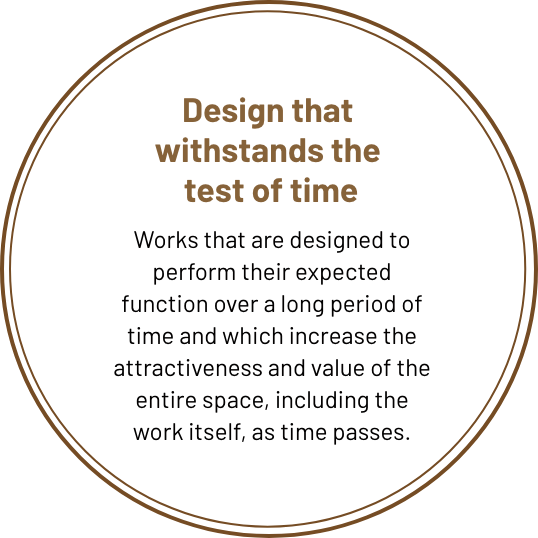
withstand the accumulation of time A work that demonstrates the expected function over a long period of time, and is designed in such a way that the appeal and value of the entire space, including the work, will increase over time.
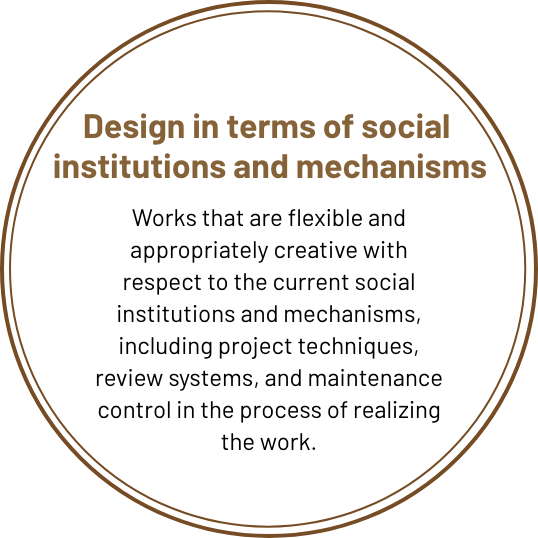
  • Design of social systems and mechanisms Works that are flexible and appropriately creative with respect to the current social systems and mechanisms, including project methods, review systems, and maintenance management in the process of realizing the work.
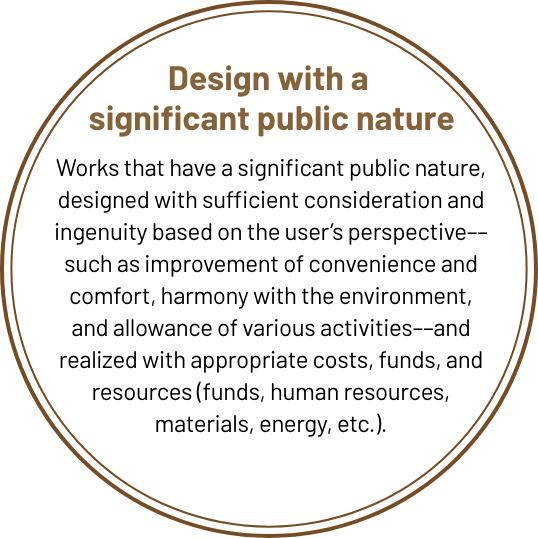
  • Design with a rich public nature Designs that have a rich public nature, with sufficient consideration and ingenuity from the user’s perspective, such as improving convenience and comfort, harmonizing with the environment, and permitting various activities, and that are realized with appropriate costs, funds, and resources (funds, human resources, materials used, energy, etc.).
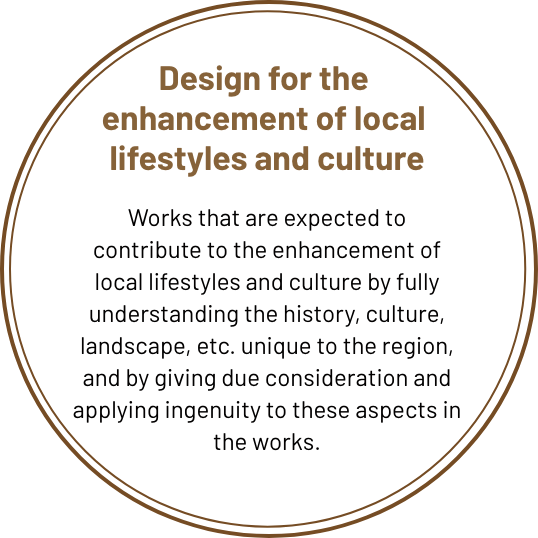
  • Design for the creation 
of local life and culture Works that are expected to contribute to the development of local lifestyles and culture by fully understanding the history, culture, landscape, etc. unique to the region, and by giving due consideration and ingenuity to these aspects in the work.